Transposition Ciphers
Identify and break transposition ciphers - rail fence, columnar, and route ciphers.
Transposition Ciphers
Transposition ciphers rearrange the letters of the plaintext without changing them. Unlike substitution, the letter frequencies are preserved - a key indicator for identification.
Overview
Key characteristics:
- Letters are not substituted - they remain the same
- Letters are rearranged according to a pattern or key
- Letter frequencies match English (E is still most common)
- Index of Coincidence (IC) ≈ 0.067 (same as English)
- Main defense: rearrangement pattern, not substitution
Why it's vulnerable:
- English letter frequency preserved → easy to identify as transposition
- Ciphertext is an anagram of plaintext
- If you know the pattern, decryption is straightforward
Identifying Transposition vs Substitution
Both transposition and monoalphabetic substitution have IC ≈ 0.067. The differentiator: in transposition, the actual letter frequencies match English (E is still the most common letter). In substitution, they're scrambled.
from collections import Counter

def index_of_coincidence(text):
    text = [c for c in text.upper() if c.isalpha()]
    n = len(text)
    freq = Counter(text)
    return sum(f*(f-1) for f in freq.values()) / (n*(n-1))

# Check letter frequencies
def check_cipher_type(ciphertext):
    freq = Counter(ciphertext.upper())
    sorted_freq = sorted(freq.items(), key=lambda x: -x[1])
    print("Top 5 letters:", sorted_freq[:5])

    # English order: E T A O I
    # If ciphertext matches this → TRANSPOSITION
    # If ciphertext scrambled → SUBSTITUTION

# Transposition: frequencies match English
# Substitution: frequencies scrambled
Quick Attack: Automated Tools
dcode.fr - All Transposition Types
dcode.fr/transposition-cipher detects and breaks most transposition ciphers automatically.
Available tools:
CyberChef
Use CyberChef's Rail Fence Cipher Decode operation:
- Open CyberChef
- Add "Rail Fence Cipher Decode" operation
- Try different numbers of rails (2, 3, 4, 5...)
Transposition Cipher Types
Rail Fence Cipher
Letters are written in a zig-zag pattern across N rails, then read rail by rail.
Encryption example:
Plaintext: HELLO WORLD
Rails: 2

Rail 1: H . L . O . O . L .
Rail 2: . E . L . W . R . D

Ciphertext: HLOOLWRD (read rail 1, then rail 2)
Rails: 3 (more complex pattern)
Rail 1: H . . . O . . . L
Rail 2: . E . L . W . R .
Rail 3: . . L . . . O . .

Read by rail: HOOLELLWRO
Tools:
- dcode.fr/rail-fence-cipher - best tool
- CyberChef "Rail Fence Cipher Decode"
Attack: Try 2, 3, 4, 5 rails. Most CTF challenges use 2-4 rails.
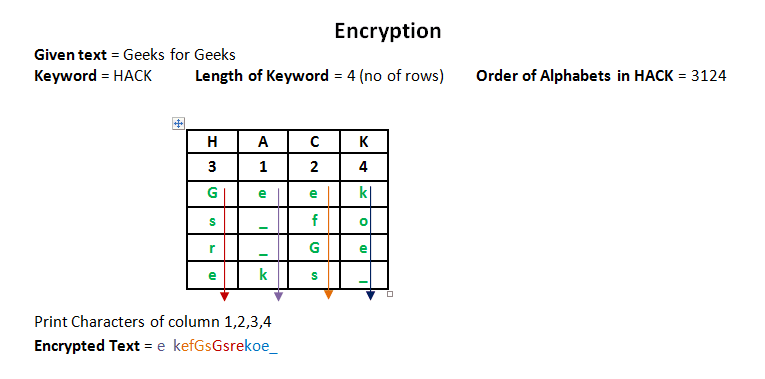
Columnar Transposition Cipher
Text is written in rows under a keyword. Columns are read in alphabetical order of the keyword letters.
Encryption example:
Keyword: HACK
Plaintext: GEEKS FOR GEEKS

Step 1: Number columns by alphabetical order of keyword
H(3) A(1) C(2) K(4)

Step 2: Write plaintext in rows:
     H  A  C  K
     3  1  2  4
     ---------
     G  e  e  k
     s  F  o  r
     G  e  e  k
     s  -  -  -

Step 3: Read columns in order 1,2,3,4 (A, C, H, K):
Column A (1): e, F, e
Column C (2): e, o, e
Column H (3): G, s, G, s
Column K (4): k, r, k

Ciphertext: eFe + eoe + GsGs + krk = eFeeoeGsGskrk
More detailed visualization:
Keyword: H A C K
Order:   3 1 2 4

Write plaintext:
   H  A  C  K
   3  1  2  4
   G  e  e  k
   s  F  o  r
   G  e  e  k
   s  -  -  -

Read columns by order (1→A, 2→C, 3→H, 4→K):
A column: e, F, e → eFe
C column: e, o, e → eoe
H column: G, s, G, s → GsGs
K column: k, r, k → krk

Ciphertext: eFeeoeGsGskrk
Tools:
- dcode.fr/columnar-transposition-cipher - enter keyword and ciphertext
- Manual decryption with Python (see below)
Attack: If keyword is hinted in challenge, use dcode.fr. Otherwise, brute force common keywords (HACK, KEY, SECRET, etc.).
Route Cipher
Text is written in a grid and read by a specific path (zigzag, spiral, diagonal, column, etc.).
Example:
Write plaintext in grid:
H  E  L  L
O  W  O  R
L  D  !  X

Read diagonally, by spiral, or by custom path depending on challenge description.
Attack:
- Check challenge description for hints about the reading pattern
- Try common patterns: zigzag, spiral (clockwise/counterclockwise), diagonal
- Use dcode.fr or write custom code
Python Code Examples
Attack Steps
Identify cipher type
Check letter frequencies. Do they match English? (E most common, then T, A, O...) If yes → transposition.
Try rail fence first
Use dcode.fr or CyberChef. Try 2, 3, 4, 5 rails. Most CTF challenges use 2-4 rails.
Check for keyword hints
Does the challenge title or description mention a keyword or column cipher? If yes → columnar transposition.
Use automated tools
dcode.fr detects and cracks most transposition ciphers automatically. Just paste and click solve.
Manual decryption
If you know the keyword and cipher type, use Python code or CyberChef to decrypt.
Identification Strategy
✓ Letter frequencies match English?           → TRANSPOSITION
✓ All original letters present?               → TRANSPOSITION
✓ Word length distribution like English?      → TRANSPOSITION
✓ "Rail" or "Fence" in challenge?             → Rail Fence
✓ Keyword hinted in challenge?                → Columnar Transposition
✓ Grid or matrix description?                 → Route Cipher
✓ Frequencies scrambled randomly?             → SUBSTITUTION (not transposition)
Tools Summary
| Tool | Use For | Link |
|---|---|---|
| dcode.fr | All transposition types | dcode.fr/transposition-cipher |
| Rail Fence | Rail fence cipher | dcode.fr/rail-fence-cipher |
| Columnar | Columnar transposition | dcode.fr/columnar-transposition-cipher |
| CyberChef | Rail fence decode | CyberChef - search "Rail Fence" |
| Python | Custom analysis | See code examples above |
Checklist
- Letter frequency = English? → Transposition (not substitution)
- Try rail fence: 2, 3, 4, 5 rails with dcode.fr
- Keyword hint? → Columnar transposition with keyword
- Grid/matrix in challenge? → Route cipher, try different reading patterns
- Short text? → Manual anagram solving
- Use dcode.fr for automatic detection and decryption
Last updated on