AES Modes of Operation
Understanding AES modes and their CTF-relevant weaknesses - ECB, CBC, CTR, and more.
AES Modes of Operation
AES itself is a secure block cipher, but the mode of operation determines how blocks are chained. CTF crypto challenges almost always attack the mode, not AES itself.
AES Fundamentals
- Block size: always 128 bits (16 bytes)
- Key sizes: 128, 192, or 256 bits
- AES processes exactly one 16-byte block at a time
For messages longer than 16 bytes, a mode of operation is required.
Visual Comparison of AES Modes
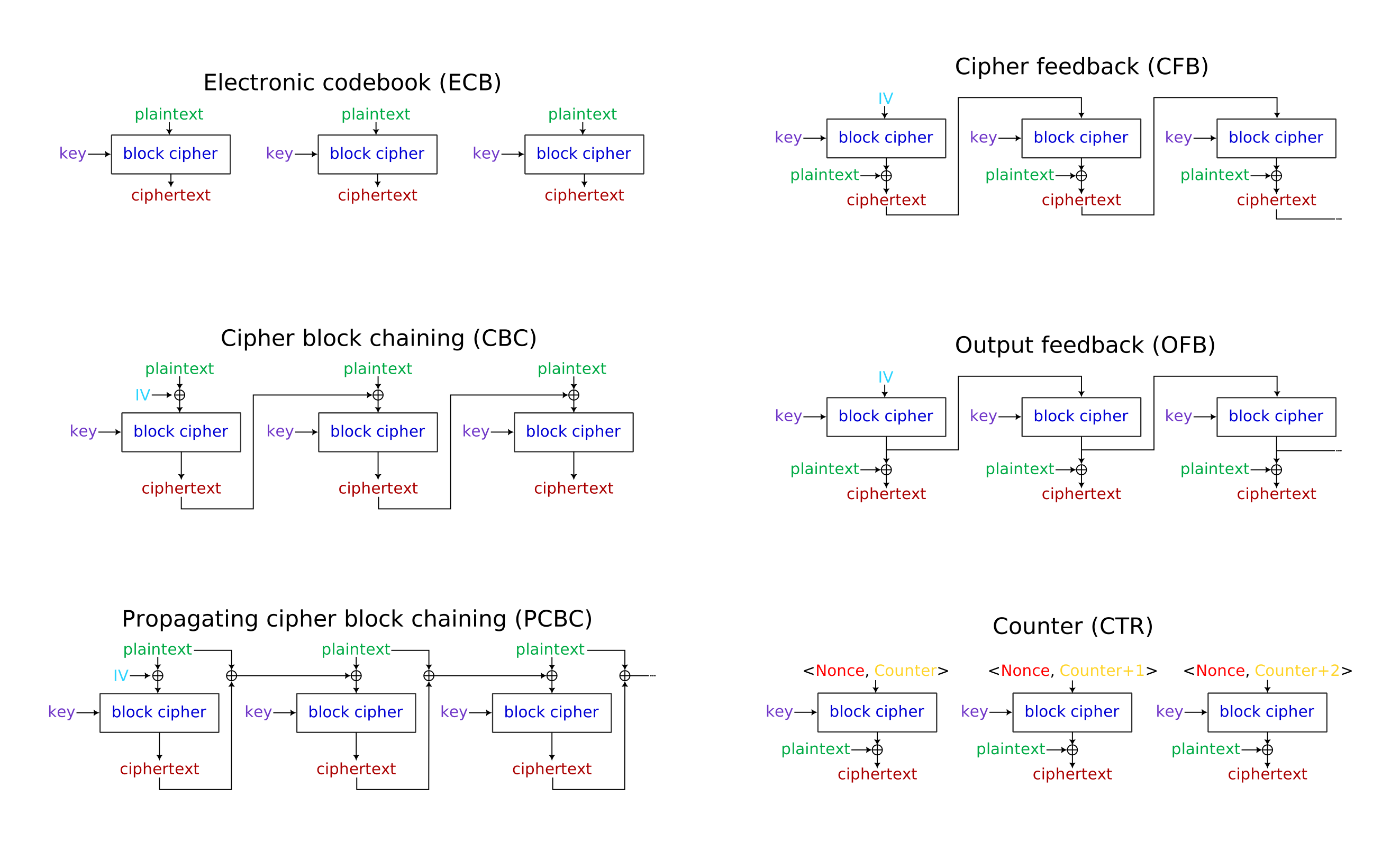
| Mode | Parallelizable | Deterministic | Use Case | Vulnerability |
|---|---|---|---|---|
| ECB | Yes | Yes (Bad!) | Legacy only | Pattern leakage |
| CBC | No | Yes (with IV) | Standard | Padding oracle |
| CTR | Yes | No (with nonce) | Streaming | Nonce reuse |
| GCM | Partial | No (with nonce) | Authenticated | Nonce reuse |
Mode: ECB (Electronic Codebook)
Each 16-byte block is encrypted independently with the same key.
Fatal Flaw
Identical plaintext blocks produce identical ciphertext blocks. Patterns in plaintext survive into ciphertext.
Classic ECB Attack: Detect Mode
# Send two identical 16-byte blocks
payload = b'A' * 32
# If any 16-byte block in ciphertext is repeated → ECB
ciphertext = oracle(payload)
blocks = [ciphertext[i:i+16] for i in range(0, len(ciphertext), 16)]
if len(blocks) != len(set(blocks)):
    print("ECB detected!")
ECB Byte-at-a-Time Oracle Attack
If you control part of the plaintext prepended to a secret:
def ecb_byte_at_a_time(oracle):
    secret = b''
    block_size = 16  # detect this first

    for i in range(256):   # for each byte position
        # Craft input that aligns known data to block boundary
        padding = b'A' * (block_size - len(secret) % block_size - 1)

        # Target block (contains one unknown byte)
        target = oracle(padding)[: ((len(secret) // block_size) + 1) * block_size]

        # Try all 256 possible byte values
        for byte in range(256):
            test = oracle(padding + secret + bytes([byte]))
            if test[:len(target)] == target:
                secret += bytes([byte])
                break

    return secret
Mode: CBC (Cipher Block Chaining)
Each plaintext block is XOR'd with the previous ciphertext block before encryption.
Bit Flipping Attack
Flipping a bit in C[i] flips the corresponding bit in P[i+1] after decryption. No key required.
# Goal: change P[1][j] from 'X' to 'Y'
# Flip bit: C[0][j] ^= ord('X') ^ ord('Y')

ciphertext = bytearray(oracle_encrypt(payload))
target_block = 0   # modify ciphertext block 0 to corrupt plaintext block 1
target_byte  = 6   # byte position within block

ciphertext[target_block * 16 + target_byte] ^= ord('X') ^ ord('Y')
# Now decrypt → P[1][6] == 'Y'
IV = Key Attack
Some implementations reuse the key as the IV (very common CTF mistake):
# If IV == Key, you can recover the key:
# Encrypt: P → C
# Decrypt C1 || 0..0 || C1
# XOR P'[0] ^ P'[2] = K

c1 = ciphertext[:16]
crafted = c1 + b'\x00' * 16 + c1
decrypted = oracle_decrypt(crafted)
key = xor(decrypted[:16], decrypted[32:48])
Mode: CTR (Counter)
A keystream is generated by encrypting a nonce+counter, then XOR'd with plaintext. CTR turns AES into a stream cipher - decryption uses the same operation as encryption.
Nonce Reuse Attack
If the same nonce (counter starting point) is reused across two messages, their keystreams are identical:
Knowing one plaintext recovers the other (and the keystream):
c1 = bytes.fromhex("...")
c2 = bytes.fromhex("...")

# If P1 is known (e.g. from context)
ks = xor(c1, known_p1)
p2 = xor(c2, ks)
Mode Detection (CTF Technique)
def detect_mode(oracle):
    # oracle(plaintext) returns ciphertext
    ciphertext = oracle(b'A' * 48)
    blocks = [ciphertext[i:i+16] for i in range(0, len(ciphertext), 16)]

    if blocks[1] == blocks[2]:
        return "ECB"
    else:
        return "CBC (or other chained mode)"
Common CTF AES Scenarios
| Scenario | Mode | Attack |
|---|---|---|
| Identical ciphertext blocks | ECB | Byte-at-a-time oracle |
| "Decrypt any token except admin" | CBC | Bit flipping |
| Encrypt-then-decrypt with same key | CBC | Padding oracle |
| Two ciphertexts, same key | CTR with nonce reuse | XOR ciphertexts |
| Fixed IV = key | CBC | Key recovery |
Quick Python Helpers
from Crypto.Cipher import AES
from Crypto.Util.Padding import pad, unpad

def aes_ecb_encrypt(key, plaintext):
    cipher = AES.new(key, AES.MODE_ECB)
    return cipher.encrypt(pad(plaintext, 16))

def aes_cbc_encrypt(key, iv, plaintext):
    cipher = AES.new(key, AES.MODE_CBC, iv)
    return cipher.encrypt(pad(plaintext, 16))

def xor(a, b):
    return bytes(x ^ y for x, y in zip(a, b))
Last updated on