ECC Basics
Understand elliptic curve cryptography fundamentals for CTF crypto challenges.
ECC
Elliptic Curve Cryptography (ECC) provides the same security as RSA with much smaller key sizes. CTF challenges use ECC for key exchange (ECDH) and digital signatures (ECDSA).
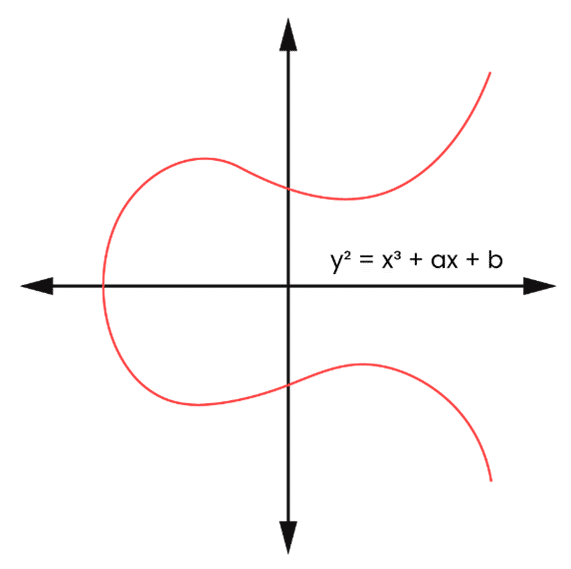
- At a high level, ECC uses points on an elliptic curve instead of arithmetic over large integers (like RSA). A point is a pair
(x, y)that satisfies the curve equation (mod p). - A private key is a small integer
d. The corresponding public key is the pointQ = d·G, whereGis a fixed generator point on the curve and·denotes scalar multiplication (repeated point addition). - Security comes from the Elliptic Curve Discrete Logarithm Problem (ECDLP): given
GandQ = d·G, recoveringdis computationally infeasible for well-chosen curves and parameters. - Common uses:
- ECDH: two parties derive a shared secret by multiplying their private scalar with the other party's public point.
- ECDSA: signing uses a per-message random scalar
kand produces a signature(r, s)derived fromkGand the signer's private key.
- Practical benefits for beginners to remember:
- Much smaller keys than RSA for equivalent security (lighter storage and bandwidth).
- Faster on devices with limited resources (important in embedded/IoT contexts).
- Beware: incorrect randomness (reusing
k) or weak curves can completely break security.
ECC vs RSA
Below is a concise comparison between ECC and RSA to help beginners understand trade-offs.
| Parameters | ECC | RSA |
|---|---|---|
| Working algorithm | ECC works on the mathematical model of elliptic curves (points and scalar multiplication). | RSA is based on the difficulty of integer prime factorization. |
| Bandwidth savings | ECC gives significant bandwidth savings due to smaller key and signature sizes. | RSA provides much lesser bandwidth saving than ECC. |
| Encryption process | Encryption (or key agreement) tends to be faster with ECC for equivalent security levels. | Encryption is slower than ECC for equivalent security levels. |
| Decryption process | Decryption (or some operations) can be slower due to certain curve operations and protocol details. | Decryption can be faster in some RSA implementations (depends on exponent choices and CRT). |
| Security | ECC is considered stronger per-bit and is widely adopted for modern systems. | RSA requires much larger keys to reach the same security margin and is losing favor for new systems. |
Key Length Comparison (approximate equivalence)
| Security (bits) | RSA key length required | ECC key length required |
|---|---|---|
| 80 | 1024 | 160–223 |
| 112 | 2048 | 224–255 |
| 128 | 3072 | 256–383 |
| 192 | 7680 | 384–511 |
| 256 | 15360 | 512+ |
Note: The ranges for ECC reflect how different curves and implementations map to security levels - standard recommendations today are at least 256-bit ECC (P-256 / secp256r1) for typical security.
What Is an Elliptic Curve?
where is prime and (non-singular).
Points on the curve form a group under a special addition operation, plus a "point at infinity" (the identity element).
Standard Named Curves
| Curve | p bits | Used in |
|---|---|---|
| secp256k1 | 256 | Bitcoin, many CTFs |
| secp256r1 (P-256) | 256 | TLS, JWTs |
| secp384r1 (P-384) | 384 | High-security TLS |
| Curve25519 | 255 | Signal, modern TLS |
| secp192r1 | 192 | Older applications |
Point Addition
The fundamental operation: given points , on the curve, is another point on the curve.
For , with slope :
For point doubling ():
Scalar Multiplication
This is fast (using double-and-add) but the inverse - finding given and - is the Elliptic Curve Discrete Logarithm Problem (ECDLP), which is computationally hard.
Python with SageMath
from sage.all import *

# Define curve secp256k1
p = 0xFFFFFFFFFFFFFFFFFFFFFFFFFFFFFFFFFFFFFFFFFFFFFFFFFFFFFFFEFFFFFC2F
a, b = 0, 7
E = EllipticCurve(GF(p), [a, b])

# Generator point
Gx = 0x79BE667EF9DCBBAC55A06295CE870B07029BFCDB2DCE28D959F2815B16F81798
Gy = 0x483ADA7726A3C4655DA4FBFC0E1108A8FD17B448A68554199C47D08FFB10D4B8
G = E(Gx, Gy)

# Key generation
n = int(G.order())       # group order
private_key = randint(1, n-1)
public_key = private_key * G

print(f"Private key: {hex(private_key)}")
print(f"Public key: ({hex(int(public_key.xy()[0]))}, {hex(int(public_key.xy()[1]))})")
Python with PyCryptodome
from Crypto.PublicKey import ECC

# Generate keypair
key = ECC.generate(curve='P-256')
print(key.d)    # private key
print(key.pointQ)  # public key

# Import from PEM
key = ECC.import_key(open('private.pem').read())

# Get public key components
Q = key.pointQ
print(f"Qx = {Q.x}")
print(f"Qy = {Q.y}")
ECDSA
from Crypto.PublicKey import ECC
from Crypto.Signature import DSS
from Crypto.Hash import SHA256

# Sign
key = ECC.generate(curve='P-256')
h = SHA256.new(b"message to sign")
signer = DSS.new(key, 'fips-186-3')
signature = signer.sign(h)

# Verify
verifier = DSS.new(key.public_key(), 'fips-186-3')
try:
    verifier.verify(h, signature)
    print("Valid!")
except ValueError:
    print("Invalid!")
ECDSA signature structure: where:
- (the -coordinate of , modulo the curve order)
ECDH Key Exchange
from Crypto.PublicKey import ECC

# Alice
alice_key = ECC.generate(curve='P-256')
alice_public = alice_key.public_key()

# Bob
bob_key = ECC.generate(curve='P-256')
bob_public = bob_key.public_key()

# Shared secret (using sage for the multiplication)
from sage.all import *
# Both compute: shared = d_alice * Q_bob = d_bob * Q_alice
Identifying Weak Curves
In CTF challenges, the curve might be intentionally weak:
from sage.all import *

# Check if curve order is smooth (small factors → Pohlig-Hellman)
E = EllipticCurve(GF(p), [a, b])
n = E.order()
print(f"Order: {n}")
print(f"Factorization: {factor(n)}")

# If n has small factors → Pohlig-Hellman ECDLP attack
# If n = p (anomalous curve) → Smart's attack
print(f"Is anomalous? {n == p}")

# Is it supersingular? (MOV attack possible)
print(E.is_supersingular())
See also
- RSA Basics - RSA overview and common attacks.
- Hash Functions - Hashing concepts used in signatures and protocols.
ECC Attacks
Elliptic Curve Cryptography (ECC) provides strong security when implemented correctly. CTF crypto challenges target implementation flaws - especially nonce reuse in ECDSA, invalid curve attacks, and small subgroup attacks.
ECC Quick Review
Curve over :
Key generation: fixed generator ; private key ; public key .
ECDSA sign (with per-signature nonce ):
where is the message hash. Verify: with , , check .
Attack: ECDSA Nonce Reuse
If the same nonce k is used for two different messages, the private key is trivially recoverable:
# Given: two signatures (r1,s1), (r2,s2) for messages m1, m2
# with the same nonce k (we know r1 == r2 since r = (k·G).x)

# s1 = k⁻¹(h1 + d·r) mod n
# s2 = k⁻¹(h2 + d·r) mod n
# → s1 - s2 = k⁻¹(h1 - h2) mod n
# → k = (h1 - h2) · (s1 - s2)⁻¹ mod n
# → d = (s1·k - h1) · r⁻¹ mod n

from Crypto.PublicKey.ECC import EccKey
import hashlib

n  = 0xFFFFFFFFFFFFFFFFFFFFFFFFFFFFFFFEBAAEDCE6AF48A03BBFD25E8CD0364141  # secp256k1

def modinv(a, m):
    return pow(a, -1, m)

h1 = int(hashlib.sha256(msg1).hexdigest(), 16)
h2 = int(hashlib.sha256(msg2).hexdigest(), 16)
r, s1, s2 = r, s1, s2  # from given signatures

k = ((h1 - h2) * modinv(s1 - s2, n)) % n
d = ((s1 * k - h1) * modinv(r, n)) % n

print(f"Private key d = {hex(d)}")
Attack: Short Nonce / Biased Nonce (Lattice Attack)
If nonces are truncated (short) or biased (e.g., MSB always 0), the private key can be recovered via a lattice (Hidden Number Problem). Requires multiple signatures.
This is solved using SageMath with LLL reduction:
from sage.all import *

# Set up the lattice for HNP
# See: https://crypto.stackexchange.com/questions/44644
# For short nonces: nonce k has top l bits = 0
# This becomes a bounded-norm vector in a lattice

n = ...   # group order
signatures = [(h1, r1, s1), (h2, r2, s2), ...]  # collected from oracle

l = 8  # number of known MSB bits of k (0)

# Build matrix and run LLL
# (Implementation omitted for brevity - use known PoC scripts)
Reference: CryptoHack Ledger Donjon CTF writeup for full implementation.
Attack: Invalid Curve Attack
If the server accepts arbitrary curve points without checking they're actually on the curve, you can send points from weak curves (with small subgroup order) to recover the private key bit by bit.
# Send a point P' on a weaker curve y^2 = x^3 + ax + b' (mod p)
# with small group order q
# Server computes d·P' and returns some function of the result
# Since q is small, brute-force d mod q
# Use CRT to recover full d from several such residues
Attack: Smart's Attack (ECDLP on Anomalous Curves)
For curves where (anomalous curves), the ECDLP can be solved in polynomial time using a lift to -adic numbers.
def smart_attack(P, Q, p):
    """Solve Q = k*P on an anomalous curve over Fp."""
    from sage.all import EllipticCurve, GF, Qp, ZZ

    E = P.curve()
    Eqp = EllipticCurve(Qp(p, 2), [ZZ(a) + p * ZZ(0) for a in E.a_invariants()])

    P_Qp = Eqp.lift_x(ZZ(P.xy()[0]))
    Q_Qp = Eqp.lift_x(ZZ(Q.xy()[0]))

    p_times_P = p * P_Qp
    p_times_Q = p * Q_Qp

    x_P, y_P = p_times_P.xy()
    x_Q, y_Q = p_times_Q.xy()

    phi_P = -(x_P / y_P)
    phi_Q = -(x_Q / y_Q)

    k = ZZ(phi_Q / phi_P) % p
    return k
Attack: MOV Attack (Supersingular Curves)
For supersingular curves (small embedding degree), the ECDLP can be reduced to a DLP in a finite field extension via the Weil or Tate pairing.
# In SageMath:
E = EllipticCurve(GF(p), [a, b])
assert E.is_supersingular()  # confirm

# Use pairings to reduce to finite field DLP
# Then use index calculus on F_{p^k}
Last updated on
RSA Attacks
A comprehensive catalogue of RSA attacks for CTF crypto: small e, Hastad, common modulus, Wiener, Boneh-Durfee, Franklin-Reiter, partial key exposure, parity oracle, Fermat, batch GCD, Pollard p-1, Coppersmith, CRT faults, and signature forgery.
ECC Attacks
A working catalogue of elliptic-curve attacks for CTF crypto: ECDLP, Pohlig-Hellman on smooth order, MOV/Frey-Ruck pairing reduction, Smart's anomalous-curve attack, singular curves, invalid-curve and small-subgroup, twist attacks, ECDSA nonce reuse and biased-nonce HNP.