RSA Basics
Understand RSA key generation, encryption, decryption, and the math behind it for CTF crypto.
RSA
RSA(Rivest-Shamir-Adleman) Algorithm is an asymmetric or public-key cryptography algorithm which means it works on two different keys: Public Key and Private Key. The Public Key is used for encryption and is known to everyone, while the Private Key is used for decryption and must be kept secret by the receiver.
How it works: Generate two large primes (p, q); modulus n = p × q; public exponent e (typically 65537); private exponent d computed using Euler's totient φ(n) = (p-1)(q-1); encryption uses C = M^e mod n; decryption uses M = C^d mod n.
Why it matters: RSA security relies entirely on factorization difficulty; small primes, shared factors, or improper padding create exploitable weaknesses; CTF challenges test prime factorization, Chinese Remainder Theorem, and Coppersmith's attack; most common asymmetric algorithm in real-world systems.
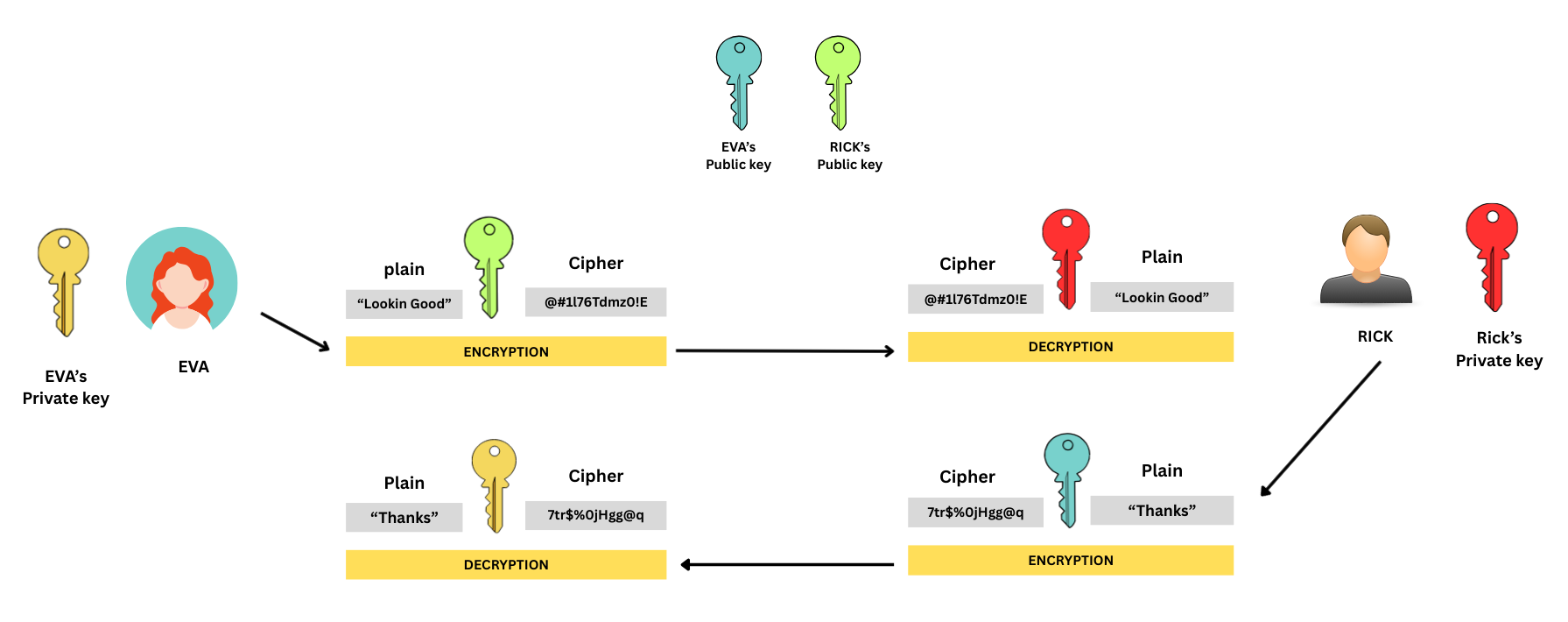
RSA Overview
RSA (Rivest–Shamir–Adleman) works on the principle that:
- Public key (n, e) is known to everyone → encrypts
- Private key d is secret → decrypts
- Computing d from n and e is computationally hard (depends on factoring n)
| Component | Who knows | Purpose |
|---|---|---|
| n (modulus) | Public | Shared by all |
| e (public exponent) | Public | Encryption |
| d (private exponent) | Secret | Decryption |
| p, q (primes) | Secret | Only owner knows |
Mathematical Foundations
Modular Arithmetic
| Concept | Definition |
|---|---|
| Remainder when is divided by (e.g. ) | |
| Modular inverse | : an integer with ; exists iff |
Euler's Totient Function
| Case | Formula |
|---|---|
| Prime | |
| (distinct primes) |
Carmichael's Lambda
For , . Some RSA implementations use instead of when computing .
RSA Algorithm
Key Generation
Choose two primes
Choose two large distinct prime numbers: p, q.
Compute modulus
Compute: n = p * q (this modulus is public).
Compute totient
Compute Euler's totient (or Carmichael ).
Choose public exponent
Choose with and (commonly ).
Compute private exponent
Compute . This is the private exponent.
Distribute keys
Public key: (n, e)
Private key: (n, d) or (p, q, d, e)
Encryption
Decryption
This works because by Euler's theorem.
Python RSA from Scratch
Explanation: Generates a small RSA keypair, encrypts a short message, then decrypts it to demonstrate end-to-end RSA.
from Crypto.Util.number import getPrime, bytes_to_long, long_to_bytes, GCD
from math import lcm

# Key generation
p = getPrime(1024)
q = getPrime(1024)
n = p * q
e = 65537
phi = (p - 1) * (q - 1)

# Verify e and phi are coprime
assert GCD(e, phi) == 1

# Private exponent
d = pow(e, -1, phi)  # Python 3.8+ built-in modular inverse

# Encrypt
m = bytes_to_long(b"Hello CTF!")
c = pow(m, e, n)

# Decrypt
m_decrypted = pow(c, d, n)
print(long_to_bytes(m_decrypted))  # → b"Hello CTF!"
When You Have p and q
Explanation: Given the prime factors p and q, compute d and decrypt ciphertext c.
from Crypto.Util.number import long_to_bytes

p = ...
q = ...
e = 65537
c = ...

n = p * q
phi = (p - 1) * (q - 1)
d = pow(e, -1, phi)
m = pow(c, d, n)
print(long_to_bytes(m))
Common RSA Parameters in CTF
CTF challenges often give you some or all of:
| Given | Typical next step |
|---|---|
| , , | Standard scenario - look for small , factorable , or known attacks |
| , , , | Compute and , then decrypt |
| , , , | Recover factors from (see below) |
| Multiple moduli | may reveal a shared prime |
Factoring n Given d
If you know d (private exponent) and want p, q:
Explanation: Uses a randomized method to recover `p` and `q` from `n`, `e`, and `d` by exploiting the relation ed − 1 = k·φ(n).

import random
from math import gcd

def factor_with_d(n, e, d):
    """Recover p and q from n, e, d."""
    # ed - 1 = k * phi(n)
    k = e * d - 1

    while True:
        g = random.randint(2, n - 2)
        t = k

        while t % 2 == 0:
            t //= 2
            x = pow(g, t, n)
            if x > 1 and gcd(x - 1, n) > 1:
                p = gcd(x - 1, n)
                return p, n // p

p, q = factor_with_d(n, e, d)
print(f"p = {p}\nq = {q}")
Reading PEM Files
Loads RSA keys from PEM files and prints the key components (public n, e; private d, p, q).
from Crypto.PublicKey import RSA

# Load public key from PEM file
with open('public.pem', 'r') as f:
    pub = RSA.import_key(f.read())
    n = pub.n
    e = pub.e
    print(f"n = {n}")
    print(f"e = {e}")
    print(f"key size = {pub.size_in_bits()} bits")

# Load private key
with open('private.pem', 'r') as f:
    priv = RSA.import_key(f.read())
    d = priv.d
    p = priv.p
    q = priv.q
See also
- ECC Basics - Elliptic Curve Cryptography overview and attacks.
- Hash Functions - Hashing concepts used in signatures and protocols.
- RSA Attacks - The full RSA attack catalogue (Wiener, Håstad, Coppersmith, common modulus, and more).
Last updated on
Asymmetric Cryptography
Index of asymmetric crypto pages - RSA basics, ECC basics, and Diffie-Hellman attacks.
RSA Attacks
A comprehensive catalogue of RSA attacks for CTF crypto: small e, Hastad, common modulus, Wiener, Boneh-Durfee, Franklin-Reiter, partial key exposure, parity oracle, Fermat, batch GCD, Pollard p-1, Coppersmith, CRT faults, and signature forgery.